Gait and dynamic movement training
Walking seems like something simple until it becomes difficult.
For a person with a motor disability, neurological injury, or difficulties maintaining balance, taking just a few steps can require considerable effort. It is not only necessary to move the legs: the person must also control the trunk, maintain stability, shift their weight from one side to the other, and coordinate each movement.
This leads to a common question during rehabilitation: how can we practice walking without asking the body to do more than it is currently capable of?
One answer lies in dynamic gait training devices, equipment that provides support while allowing the user to participate in the movement. The idea is simple: provide assistance when needed without preventing the body from moving.
What Really Happens When We Try to Walk?
When you walk, you probably do not think about everything your body is doing. You take a step, shift your weight from one leg to the other, and continue moving forward.
But behind this movement is constant coordination.
The pelvis shifts, the center of gravity moves slightly up and down, and weight is transferred from one lower limb to the other. At the same time, the trunk needs to remain stable while one leg stays supported and the other prepares to move forward.
That is why, in rehabilitation, it is not always enough to help a person remain standing. It is also necessary to work on the movement that occurs while they are trying to walk.
And this is where the concept of dynamic gait training begins to become important.
We invite you to read: What Is Technical Support and How Does It Benefit People with Disabilities?
What Are Dynamic Gait Training Devices?
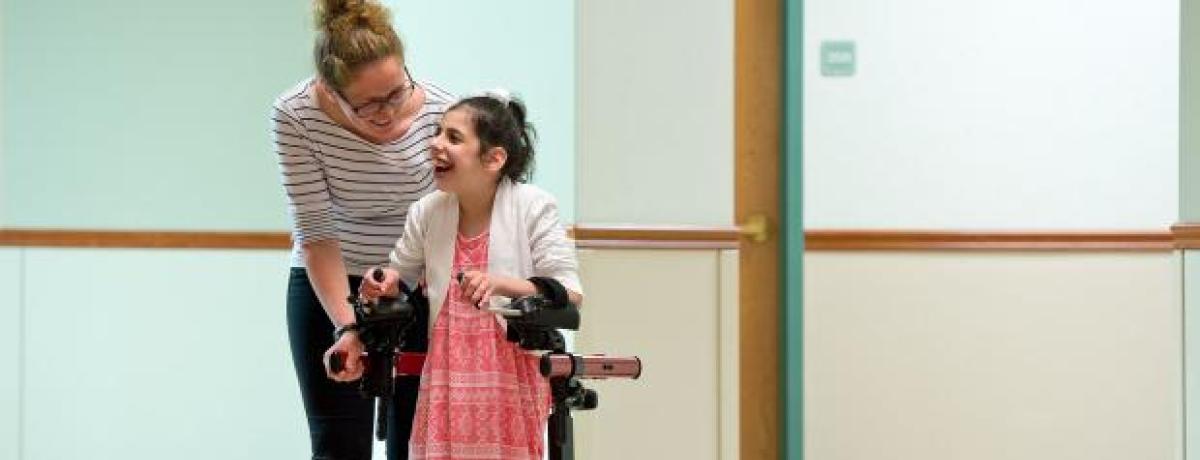
Dynamic gait training devices are support systems used in rehabilitation to facilitate gait training while allowing certain body movements.
Unlike a completely static system, the device can accommodate some of the shifts that occur while taking steps.
Depending on the model, it may provide:
-
Partial body weight support;
-
Lateral pelvic movement;
-
Vertical displacement;
-
Adjustable trunk support;
-
Stability during gait;
-
Greater freedom to shift weight;
-
Different levels of assistance according to the user's needs.
This creates an environment where the person can practice walking more safely while the therapist controls the level of difficulty.
What Is Special About Truly Dynamic Gait?
Here is an interesting detail: when you walk, your body does not move only forward.
The center of gravity, which is located approximately around the pelvis, makes small vertical and lateral movements. The scientific content on which this article is based estimates an average vertical displacement of approximately 5 centimeters during gait and a lateral displacement of approximately 2 inches.
It may not seem like much, but these movements are part of how the body distributes weight and prepares for each step.
That is why, when we talk about dynamic systems, we are referring to equipment that allows these movements to occur to some extent.
It is not about leaving the user without support. It is about finding a balance between “I fully support you” and “you have to do everything on your own.”
How Do These Devices Help During Rehabilitation?
Every person comes to therapy with different abilities. Some may be able to stand for a few seconds, others may require significant assistance, and others may be able to walk but have difficulty controlling their balance or coordinating their movements.
Dynamic devices can help adapt training to that starting point.
For example, they can help the user:
-
Practice the movement of walking repeatedly;
-
Partially reduce the load they need to support;
-
Experience weight shifting between the legs;
-
Work on pelvic control;
-
Gradually increase their participation during each step;
-
Train in a controlled and supervised environment.
The key is progression. The goal should not be to maintain the same level of assistance indefinitely, but to adjust it according to the person's progress and the goals established during therapy.
What Benefits Can Dynamic Gait Training Devices Provide?
Benefits depend on each user and on how the equipment is used. Even so, there are several reasons why these systems have attracted interest in rehabilitation.
A Walking Experience Closer to Natural Movement
Allowing the pelvis and center of gravity to move to some extent may help practice a less rigid gait pattern.
Greater User Participation
The device provides support while allowing the person to remain actively involved in the task. This is especially important when working on motor learning.
Adjustable Support Levels
Not everyone requires the same level of weight unloading. Some systems allow the amount of support to be modified to match the user's abilities.
Repeated and Controlled Practice
Learning or recovering a movement requires practice. A safe therapeutic environment can make it easier for the person to repeat steps without unnecessary exposure to the risk of falling.
Working on Different Components of Gait
Training can focus on aspects such as balance, weight transfer, coordination, postural control, and leg movement.
What Is the Difference Between a Static and a Dynamic System?
The difference does not mean that a static system is incorrect or that a dynamic system is appropriate for everyone. They simply offer different possibilities.
|
Feature |
Static System |
Dynamic System |
|---|---|---|
|
Stability |
High |
High, with the possibility of movement |
|
Pelvic Movement |
More restricted |
Allows greater freedom |
|
Weight Transfer |
May be limited |
Can be accommodated during steps |
|
Vertical Movement |
More limited |
Can accommodate body movement |
|
Active Participation |
Depends on the system |
Designed to facilitate greater participation |
|
Adaptation During Gait |
More limited |
Can adjust to movement |
The choice will depend on the user's assessment. In some cases, it may be necessary to begin with greater stability and, as the person progresses, introduce greater freedom of movement.
Why Is Dynamic Body Weight Support Important?
This point may be a little more technical, but it is essential.
When a person has difficulty walking, it may be necessary to temporarily reduce the amount of weight they have to support. This allows them to practice movement without immediately facing the full demands of walking.
Body weight support systems make it possible to train under these conditions.
In a static system, the support may remain at a fixed length while the body moves up and down during each step. This can cause changes in strap tension.
Dynamic systems are designed to accommodate these movements and maintain a more consistent level of unloading.
The study by Hidler and colleagues on the ZeroG system, published in 2011, specifically analyzed a gait and balance training system with body weight support.
Who Can Use a Dynamic Gait Training Device?
This is where it is important not to settle for an overly general answer.
Having cerebral palsy, a neurological injury, spasticity, or a neuromuscular condition does not automatically mean that a person should use this type of equipment.
Before recommending it, a healthcare professional should assess the user's abilities and needs.
Factors that may be evaluated include:
-
Head and trunk control;
-
Weight-bearing ability;
-
Balance;
-
Muscle strength;
-
Range of motion;
-
Extremity control;
-
Ability to actively participate;
-
Functional rehabilitation goals.
Based on this assessment, it is possible to determine what type of support the person needs and which device may be best suited to their rehabilitation process.
You may also be interested in: Recommendations to Prevent the Development of Pressure Ulcers
What Can We Expect From Dynamic Gait Training?
If a person has difficulty walking, the goal should not simply be to help them take a few steps. It is also important to consider how they take those steps and how much they can participate in the movement.
Dynamic gait training devices can provide a way to work on these aspects within a controlled environment, providing support without completely eliminating the movements that are part of walking.
Available research shows promising results and continues to evolve. For this reason, these devices can be a valuable tool in certain rehabilitation processes, provided that their selection and configuration are based on each user's needs.
At Loh Medical, we understand that recovering or developing mobility is an individual process. That is why selecting a rehabilitation solution should begin with a professional assessment and the specific goals of each person.