Neurological bath chairs
Neurological Bathing Chairs
Bathing a child who cannot support their own body is different from bathing any other child. No trick or amount of patience can compensate for the lack of proper support. One false move, one slippery surface, and the risk is there.
Luckily, there is a product designed exactly for this problem: neurological bathing chairs. These are not just any common shower chair with a different name. They are devices with clinical criteria, designed to support, position, and protect children with physical disabilities of neurological origin.
In the following lines, we will resolve the most common questions: what features a good model should have, what really changes for the child and their caregiver, and what to ask a provider before purchasing.
The real problem behind bath time
Independent grooming is a developmental milestone. But when a neurological condition (cerebral palsy, spina bifida, developmental delay) is involved, that milestone moves a little further away. Trunk and head control are not always present, communication can be limited, and behavior adds another layer of complexity to the process.
And what happens without the right product? Falls. Slips. Forced postures that end in pain or skin lesions due to prolonged friction. And for those caring for the child, holding them in their arms for every bath, day after day, eventually takes a physical toll.
The solution: what a neurological bathing chair really is
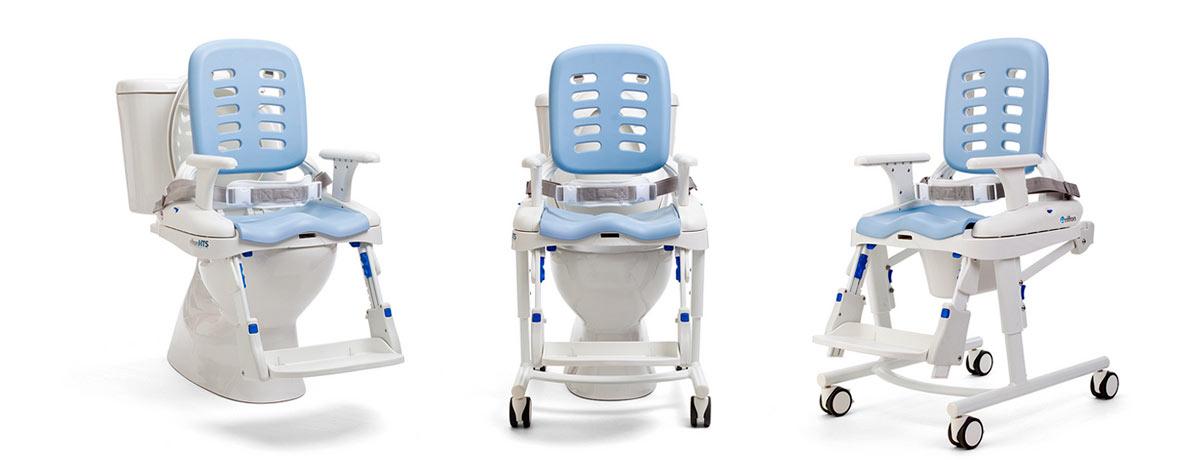
It is an assistive device designed to support, position, and stabilize children with physical disabilities of neurological origin. Unlike a conventional shower chair, it incorporates lateral supports, a restraint harness, and an adjustable headrest, and it can be used over the toilet, off the toilet with its own base, or inside the shower.
The question that really matters is not "which chair to buy?" It is "what does this particular child need?". The diagnosis and the level of motor control should guide the choice, not age or the available budget.
We invite you to read Wheelchairs for neurological conditions: how to choose the right one according to the diagnosis?
The next problem: not all chairs solve the same thing.
This is where many families and institutions go wrong: they buy the first bath chair they find, without checking if it solves the specific problem they are facing. These are the points that really make a difference.
The child grows, the chair shouldn't become too small
A child does not stop growing, and buying new equipment every year is not viable for either a family or an institution. Models worth investing in allow for adjustments in width, depth, and height, accompanying several years of growth without losing functionality.
Without head and trunk support, there is no safe posture
The seat and backrest should tilt the body into a natural, forward-leaning posture, which facilitates toilet use and transfers. When head control is limited, an adjustable headrest is no longer an extra: it becomes indispensable. You may also be interested in How to strengthen head control and stability in children with cerebral palsy?, a problem closely related to this point.
Water is unforgiving to weak materials
Stainless steel, durable plastics, padding that cleans quickly. Without these, constant humidity ends up deteriorating the product and complicating something that should be simple: keeping it hygienic.
One product, various scenarios
Over the toilet with a fixed or mobile base, off the toilet with a commode bucket, or in the shower with an independent base. The best systems adapt to all of this without forcing you to buy three different products for three different situations.
Within its Bath and Hygiene line, Loh Medical offers two solutions that respond to different needs: the HTS Toilet System and the Wave Bath Chair. Here is how they compare:
|
Feature |
HTS Bath Chair |
Wave Bath Chair |
|---|---|---|
|
Main use |
Toilet, on and off, with mobile or fixed base |
Bathtub and shower |
|
Adjustability |
Width, depth, and height; grows with the child |
Adjustable seat and backrest angle |
|
Supports |
Adjustable headrest, tool-free |
Head controls, chest and leg straps |
|
Transfers |
Frontal design intended for efficient transfers |
Tub transfer base for larger users |
|
Ideal for |
Daily grooming and intimate hygiene routines |
Full bath or shower with extended postural support |
So, what really changes when choosing well?
The difference is not just comfort. When the product is the right one:
-
The risk of falls decreases in a real way, not just on paper.
-
Grooming becomes more hygienic because the design allows for thorough cleaning after each use.
-
Many children begin to participate in their own grooming instead of depending entirely on an adult.
-
The caregiver stops carrying the full literal weight of the process, bath after bath.
-
The product lasts, because it grows with the child instead of being outgrown the following year.
The problem of hiring just anyone
Not just any salesperson can answer with clinical judgment when you ask which chair is suitable for a specific diagnosis. And that is the real risk of buying based solely on price: you end up with a product that does not solve the problem you had in the first place.
A company with a real track record in assistive technology like Loh Medical, with over 20 years of experience and presence in more than 25 countries, recommends based on the diagnosis, not based on what they have available in the warehouse.
Before deciding, these are the things worth asking:
|
Aspect to evaluate |
What should a specialized provider offer? |
|---|---|
|
Clinical advice |
Recommendation based on diagnosis, not just size or budget |
|
Configuration |
Adjustment of the product to the user's actual measurements and needs |
|
Training |
Teaching caregivers about correct use and safety adjustments |
|
Maintenance |
Periodic inspection of screws, welds, and wear-and-tear parts |
|
Spare parts |
Availability of original parts authorized by the manufacturer |
|
After-sales support |
Agile contact channel for questions or product failures |
And maintenance is not a minor issue: periodically checking for looseness, cracks, or signs of instability is what prevents a structural failure that could result in an injury. A specialized provider accompanies that process from day one, not just at the moment of sale.
How do I choose the right one for my case?
There is no single answer, and anyone who gives you one without knowing the case is likely wrong. It depends on the diagnosis, the available space in the bathroom, whether you need to use it over the toilet or in the shower, and how much the child will grow in the coming years. The most sensible thing is not to decide alone: talk to the clinical team and the provider before buying.
A well-chosen neurological bathing chair does not just solve a mobility problem. It solves something more human: the possibility for a child to bathe with safety and a bit of dignity, and for the person caring for them not to end up exhausted in the attempt.
Request advice and a quote
If you are about to equip a home, an institution, or a rehabilitation center, at Loh Medical we have spent over 20 years helping people choose well, not just selling. Contact us and tell us about the case: we will help you find the chair that actually works.
Write to us today and solve the bathing problem once and for all.